

Heavy Metals and Anxiety: Could Toxic Burden Be Affecting Your Mind?
Could Toxic Burden Be Feeding Anxiety, Apprehension, and Mental Overload?
When most people think about heavy metal toxicity, they think about physical symptoms first: fatigue, headaches, gut problems, joint pain, poor sleep, maybe brain fog.
But I think one of the most overlooked parts of the story is the psychoemotional side.
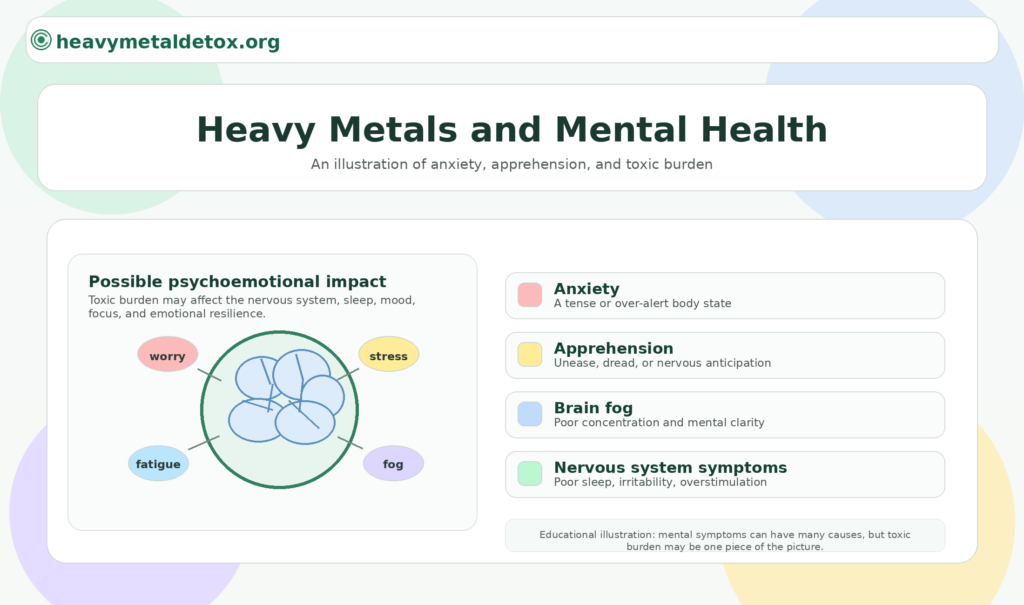
I’m talking about the person who feels unusually anxious, apprehensive, irritable, emotionally fragile, mentally overstimulated, or unable to relax properly in their own body.
That does not mean heavy metals are the cause of every case of anxiety or low mood. They are not.
But the science is becoming harder to ignore: metals such as lead, mercury, and cadmium can affect the nervous system, stress biology, sleep, cognition, and mood-related pathways in ways that may show up emotionally as much as physically.
What makes this especially relevant now is that heavy metal exposure is no longer just a story about dramatic poisoning.
It is increasingly a story of chronic, low-level, mixed exposure through food, water, fish, dust, soil, old infrastructure, smoking, and the wider environment.
The World Health Organization states that there is no known safe blood lead concentration, and even low levels may be associated with decreased intelligence, behavioural difficulties, and learning problems in children.
That matters because if a toxic metal can quietly alter brain development and behaviour, it is not a leap to ask what lower-grade, long-term exposure might be doing to stress tolerance, mood, or emotional regulation in the wider population.
Anxiety is not always “just in the mind”
One of the biggest mistakes I see is treating anxiety as if it lives only in thoughts.
Anxiety is also a body state. It involves the autonomic nervous system, inflammation, hormones, neurotransmitters, sleep, the gut-brain axis, and the stress-response system.
A 2024 systematic review on lead exposure, glucocorticoids, and physiological stress concluded that lead appears capable of disrupting the hypothalamic-pituitary-adrenal axis, one of the core systems involved in stress regulation across the life course.
That is important because when the biology of stress becomes distorted, a person may feel chronically keyed up, more vulnerable to fear, or less resilient under ordinary pressure.
In real life, that often does not look like “toxicity” at first. It looks like a nervous system that is always slightly braced. It looks like apprehension. Like feeling wired but tired. Like being more emotionally reactive than usual. Like poor sleep that never really restores you.
That is one reason I think toxic burden can be missed for so long. People describe emotional symptoms, but the physiology underneath may be part of the real story.
The EPA’s current mercury page is striking on this point: prolonged or acute exposure to elemental mercury vapour can cause mood swings, irritability, nervousness, excessive shyness, insomnia, headaches, and poor performance on tests of mental function.
Mercury has one of the clearest emotional profiles
Mercury is a neurotoxin, and the emotional pattern it can produce is surprisingly recognizable.
EPA notes that elemental mercury exposure can lead to nervousness, irritability, mood changes, and insomnia, while high exposure to inorganic mercury can be associated with mood swings, memory loss, and mental disturbances.
This is one of the clearest official examples of a toxic metal affecting the psychoemotional state directly.
I think this matters because many people with nervous-system stress do not describe themselves as “neurologically unwell.”
They simply say they feel more anxious, more brittle, more easily overwhelmed, less able to cope, less able to think clearly.
If mercury is affecting sleep, memory, neurochemistry, and nerve function at the same time, then the emotional fallout makes sense. It is not “all psychological.” It may be a psychologically experienced expression of a biologically stressed system.
Lead is not just a child IQ story
Lead is still too often discussed as if it were only about childhood IQ. That is part of the story, but not the whole story.
WHO notes that lead causes long-term harm in adults too, including high blood pressure and kidney damage, and that lead is stored in bones and teeth, where it can accumulate and later re-enter circulation.
The same WHO summary also notes that even relatively low levels may be linked with behavioural and learning difficulties in children.
Meanwhile, the 2024 systematic review on lead and glucocorticoids suggests that lead may alter the body’s stress response itself.
Taken together, that paints a broader picture: lead may influence attention, behaviour, and stress physiology, not just cognition in a narrow academic sense.
That is one reason I think lead deserves more attention in adults who present with a combination of brain fog, irritability, poor concentration, headaches, fatigue, and low stress tolerance.
It is not that lead explains every case. It is that the biology is plausible enough that it should not be brushed aside.
The newer studies are linking metals with anxiety and depression
What really makes this topic feel current is that newer human studies are now connecting heavy metals with mental health outcomes more directly.
A 2024 NHANES-based study found that blood cadmium was positively associated with anxiety in U.S. adults, and that combined exposure to cadmium, lead, and mercury was also positively associated with anxiety risk.
In that analysis, cadmium made the largest contribution to the mixture effect.
Depression is showing up in the literature too. A 2024 NHANES analysis found positive associations between several metals — including cadmium, cobalt, lead, antimony, and tungsten — and the prevalence of depression, and suggested that sleep duration partly mediated that relationship.
A separate 2024 prospective cohort study in young adults found that higher blood cadmium levels were associated with more severe depressive symptoms, with the authors pointing toward oxidative stress, inflammation, and disrupted amino-acid metabolism as possible mechanisms.
This is where the picture gets more interesting to me. We are not looking at a single isolated paper anymore. We are seeing a pattern: toxic metals may influence anxiety, depression, sleep, cognition, and stress reactivity, especially when exposures are chronic and mixed.
That does not prove causation in every person. But it does make heavy metals a much more serious part of the psychoemotional conversation than many people realize.
The gut-brain axis may be part of the missing link
One of the most cutting-edge parts of this whole topic is the gut-brain axis. A 2024 systematic review of animal studies concluded that heavy metal exposure can alter both the brain and the gut microbiota, and that these changes may affect gut-brain communication and behaviour.
The authors linked heavy metal exposure to microbial dysbiosis and changes in brain-related outcomes, including learning and mood-related behaviours in the animal literature.
I think this may help explain why heavy metal toxicity can feel so “whole body.” A person may not just have one neat symptom.
They may have digestive issues, food sensitivity, poor sleep, low emotional resilience, anxiety, and brain fog all at once.
If toxic metals are affecting the microbiome, inflammatory signalling, and the nervous system together, that cluster of symptoms becomes a lot easier to understand.
Inflammation may be the bridge between toxicity and mood
Another important angle is inflammation. The psychoemotional effects of toxic metals may not be separate from the physical ones at all.
A 2024 NHANES study found that combined exposure to lead, cadmium, and mercury was associated with higher systemic inflammation, measured by C-reactive protein.
If toxic metals are feeding oxidative stress and low-grade inflammation, that could be one way they shape mood, energy, sleep, and mental clarity.
This is why I’m cautious about separating symptoms into “physical” and “mental” as if they live in different worlds.
A person may feel physically heavy and emotionally wired because the same toxic burden is pushing on both systems at once.
So what can someone actually do?
The first step is not to panic. It is pattern recognition.
If someone has anxiety, apprehension, poor sleep, irritability, or emotional overload alongside fatigue, headaches, brain fog, digestive issues, or a known exposure history, I think toxic burden deserves a place in the bigger picture.
That is especially true where there is a history of high-mercury fish intake, smoking, occupational exposure, older housing, contaminated water, or imported products.
The second step is to remember that detox has to respect biology. A sensitive nervous system usually does not respond well to aggressive “quick cleanses” that simply stir toxins up. For someone already dealing with anxiety or mental overstimulation, that approach can backfire badly. (Detox Metals)
A structured answer: Dr Georgiou’s HMD protocol
This is where Dr Georgiou’s HMD protocol offers a more structured answer. According to Detox Metals, the protocol is built around three phases rather than one vague detox product: mobilization, binding, and elimination.
The first stage is mobilization, using HMD® to help gently pull heavy metals from cells and tissues.
The second stage is binding, using HMD® Organic Chlorella with meals to help bind metals outside the cell and reduce the chance of reabsorption.
The third stage is elimination, using HMD® Lavage to support the body’s detox pathways — especially the liver and kidneys — so that mobilized toxins can actually leave the body.
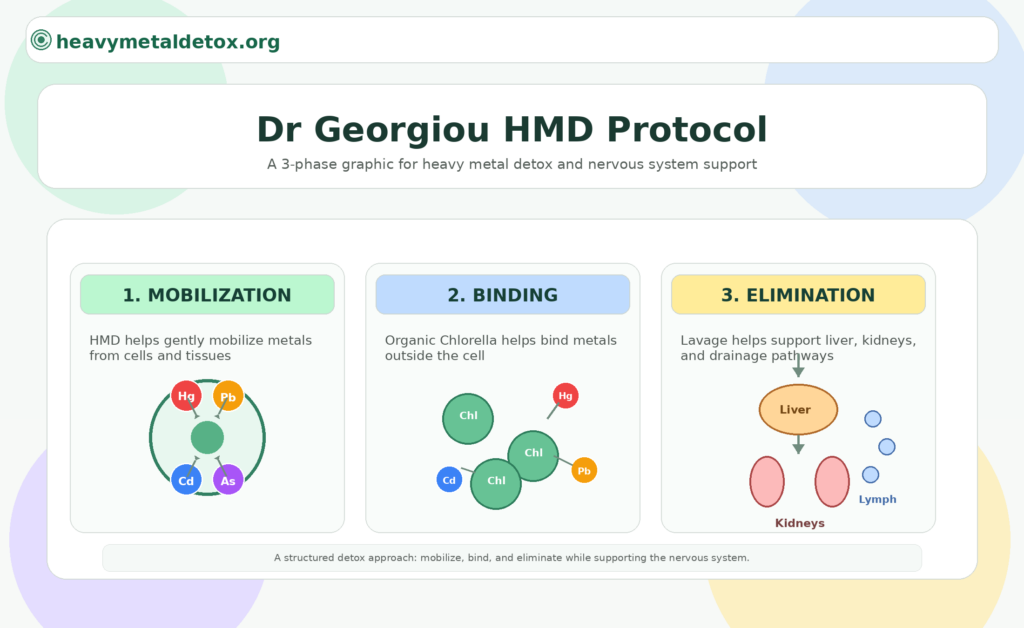
Detox Metals’ own protocol pages frame this as a biologically safer sequence than simply trying to flush toxins aggressively.
That three-part logic matters. Detox Metals explicitly warns about the “redistribution trap”: mobilising toxins too quickly without sufficient binding and drainage support, so the metals circulate and re-settle rather than exit properly.
Their current guidance presents the HMD approach as the antidote to that problem: don’t just mobilize — bind, then support the exit routes as well.
The current published adult guidance on Detox Metals is HMD® 45 drops three times daily, HMD® Lavage 25 drops three times daily, and HMD® Organic Chlorella 2 capsules twice daily with meals, usually as part of a 90-day programme.
The same guidance says that more sensitive people — including those with chronic illness or neurological issues — may do better starting lower and increasing gradually, while staying well hydrated and ideally working with a qualified practitioner.
For someone whose toxic burden may be showing up not only as fatigue or brain fog, but also as anxiety, apprehension, irritability, and a chronically “wired” nervous system, that gentler structure makes sense to me.
Instead of forcing detox, the HMD model is designed to support safe mobilization, effective binding, and proper elimination together.
The bottom line
Heavy metals are not just a physical-health issue. They may also shape the psychoemotional terrain of a person’s life — how safe the nervous system feels, how well a person sleeps, how much stress they can tolerate, how stable their mood is, and how clearly they can think.
The current science does not prove that every case of anxiety, depression, or emotional overload is caused by toxic metals.
But it does show that metals can affect stress biology, sleep, inflammation, cognition, mood, and the gut-brain axis in ways that make those symptoms biologically plausible.
Sometimes the anxious mind is not only reacting to life. Sometimes it is also reacting to a body under toxic pressure. And when that is part of the picture, the answer is not a reckless cleanse.
It is a smarter one: mobilize gently, bind effectively, and support elimination properly — which is exactly how Dr Georgiou’s HMD protocol is designed to work.